


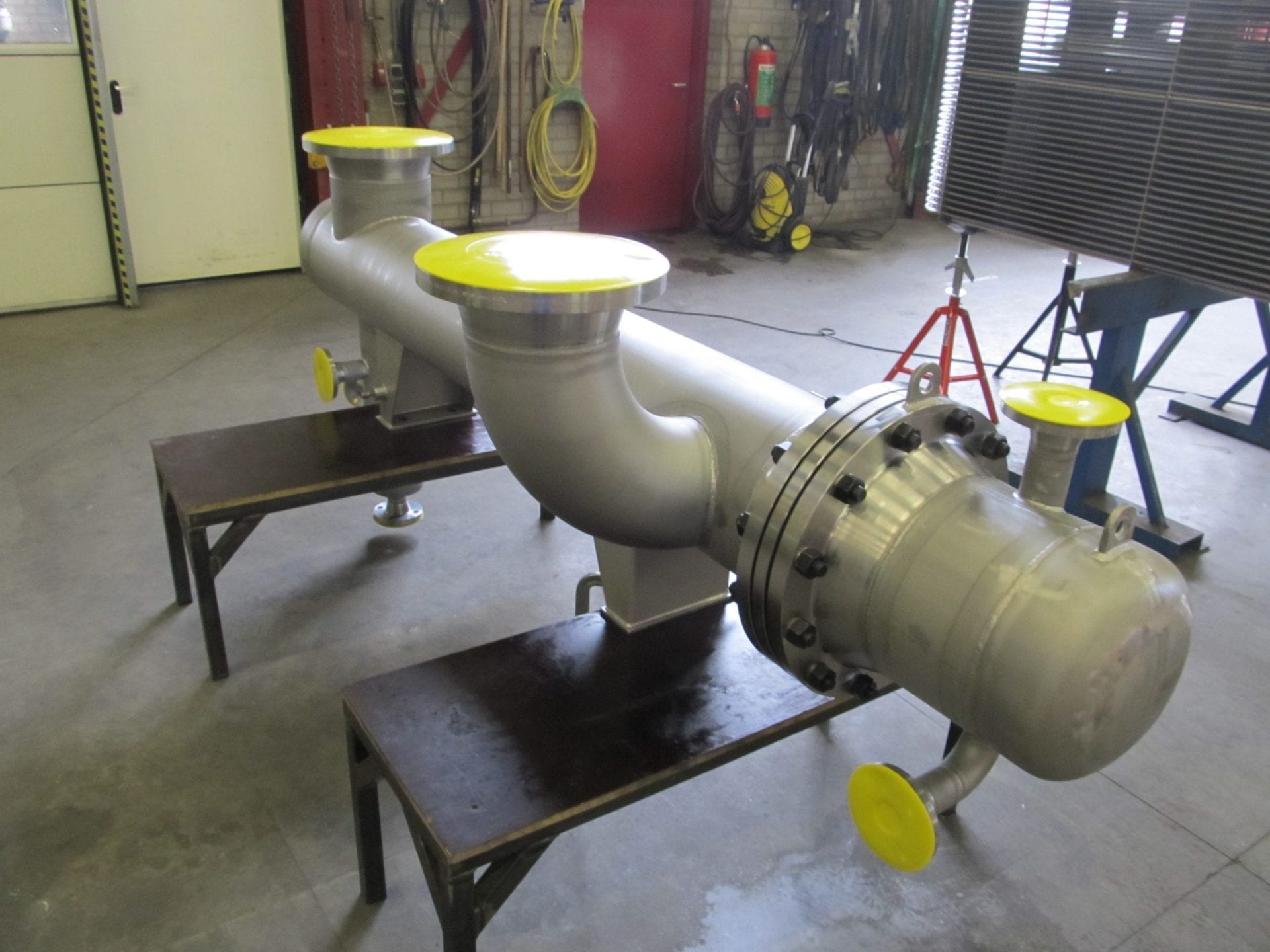
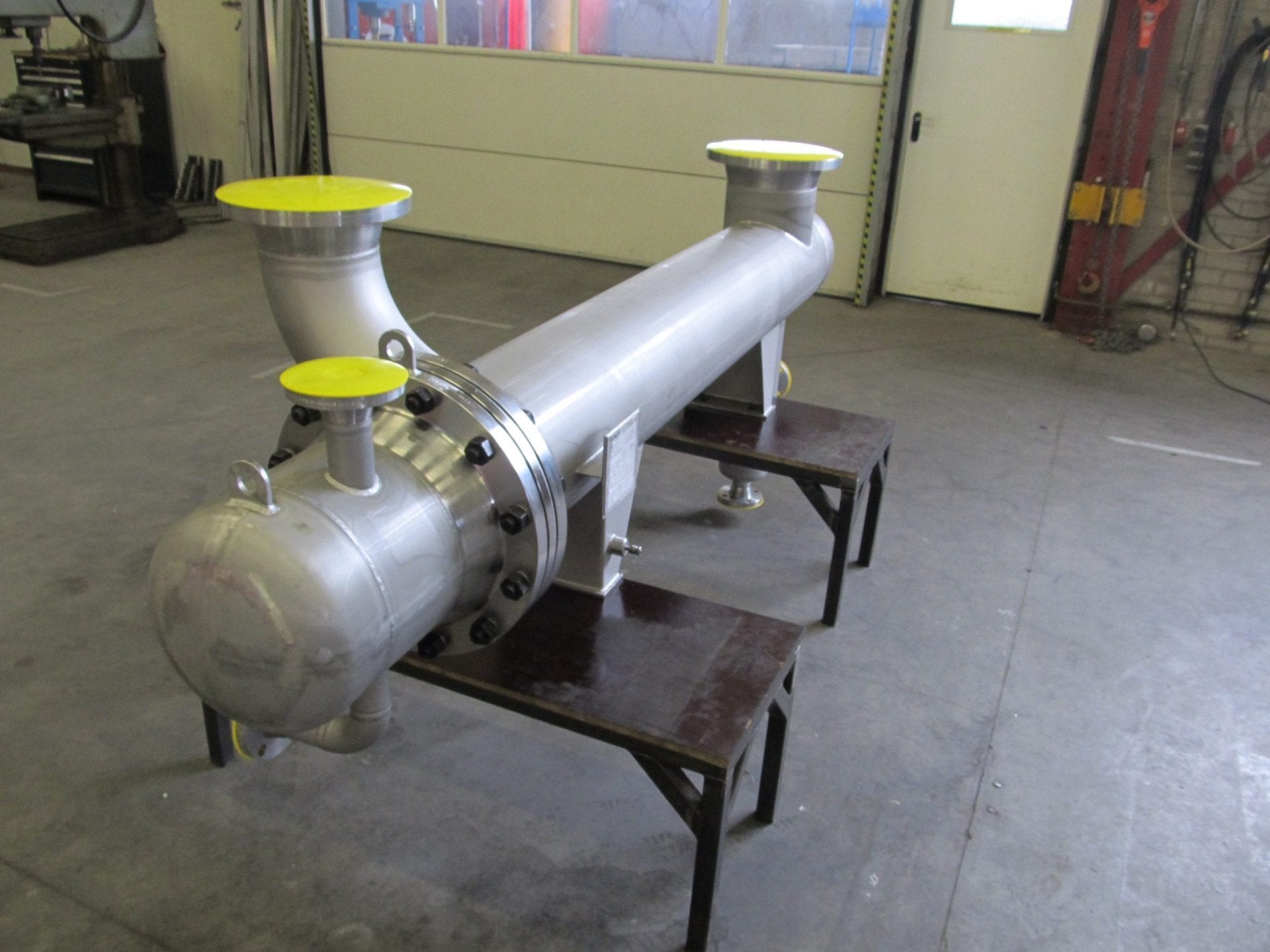
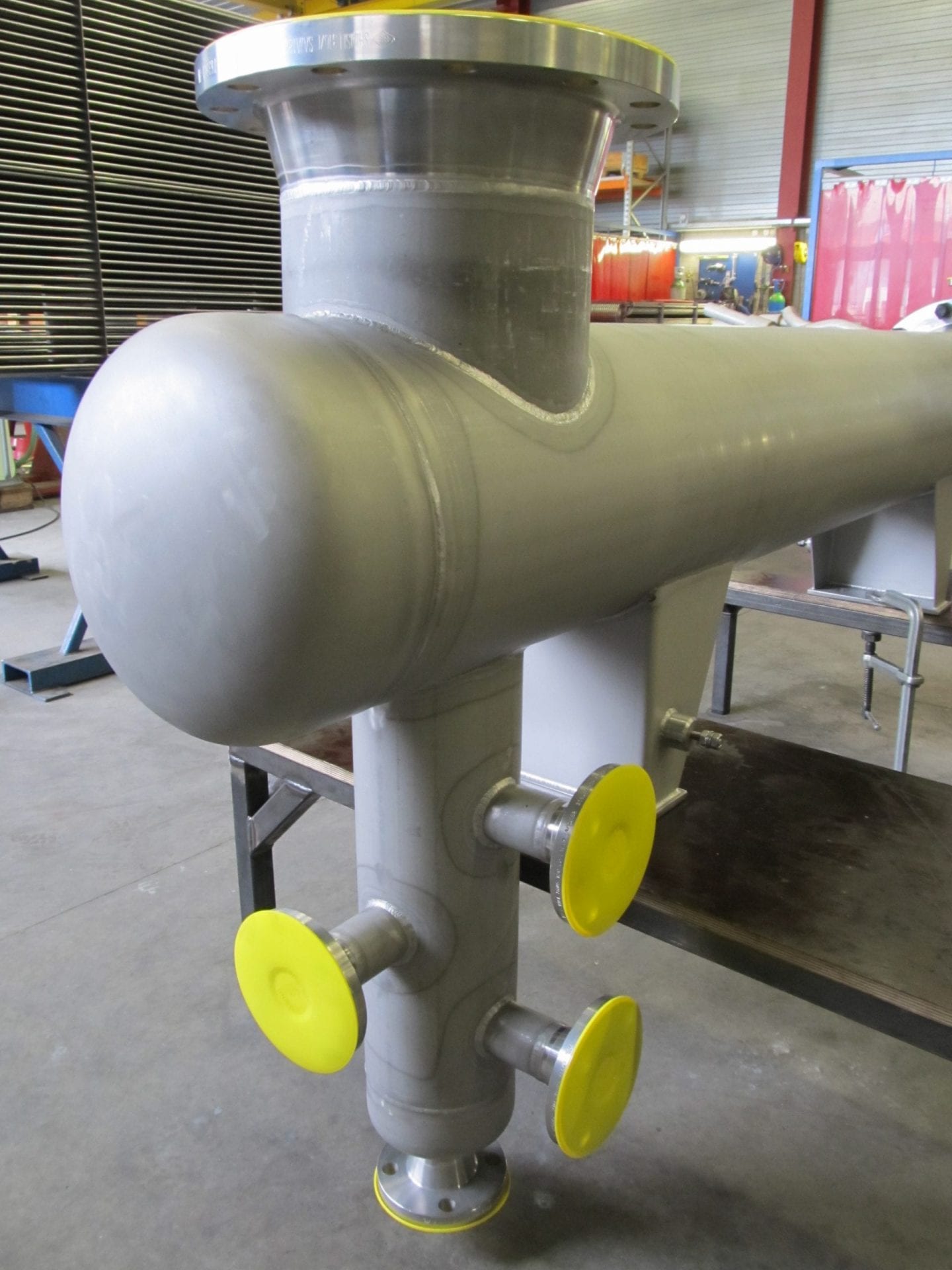
Cooling is achieved by means of Gas Coolers designed as shell & tube heat exchangers. In this process, the gas is cooled using cooling water. Normally, there is no phase transition; however, should this unexpectedly occur, an outlet sump is located at the exit to collect condensate. The sump features connections for level control.
Due to the deep vacuum in which these coolers operate, there is a high volume flow. Pressure drop is critical for such systems as it partly determines the size of the pump. Since situations may arise during operation where condensation occurs, measures must be taken to ensure the heat exchanger is suitable for this.
To keep the pressure drop as low as possible (only 0.2 mbar), large nozzles and a no-tubes-in-window (NTIW) design have been applied. This means that no tubes are placed in the window (the space above the baffle), allowing for a larger flow area. Due to the potential presence of condensate (droplets), an impingement plate was mounted above the bundle at the inlet. At the outlet, there is an outlet sump with level control connections.
Due to the ability to simulate complex gas flows at low pressure and potential condensation of various components, Robox successfully collaborates with parties from the vacuum industry. By being involved early in the design phase, significant gains can be achieved in the sizing of the entire system.